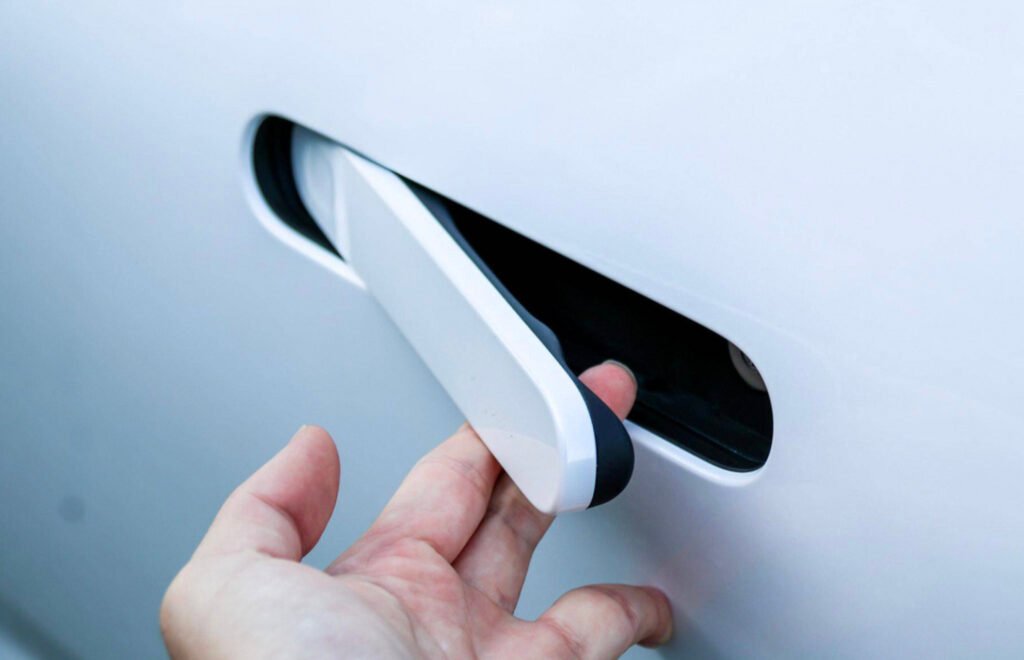
China has introduced a new mandatory national safety standard prohibiting hidden or electric door handles on vehicles, a design popularized by Tesla and widely adopted in the electric vehicle industry.
The Ministry of Industry and Information Technology (MIIT) announced the regulation on February 2, which will take effect on January 1, 2027. It requires all electric vehicles (EVs) sold in China to be equipped with standard mechanical door handles, both inside and outside the vehicle. For models already approved for sale or scheduled for launch, the deadline to complete necessary design changes is extended to January 1, 2029.
Key Requirements of the New Standard
- Exterior Handles: Must remain mechanically operable to open doors even after a crash, irreversible restraint system failure, or a power battery thermal runaway event. They must function without electrical power.
- Interior Handles: Every door must have at least one independent, mechanical release handle that directly opens that specific door.
Context and Rationale
The regulation addresses growing safety concerns. While hidden and electric handles are praised for their sleek aesthetics and aerodynamic benefits, they have been linked to critical risks in emergencies. The MIIT cited incidents where power failure or vehicle damage rendered doors impossible to open from the outside, hindering rescue efforts.
A notable case involved a Xiaomi SU7 sedan that caught fire after a collision in October 2025. Rescuers were unable to open the doors, leading to the driver’s death and sparking intense public debate over the safety of such designs.
This move marks a significant shift for automakers, especially EV brands that had made hidden handles a signature design element, and signals a stronger regulatory focus on passive safety in the era of electrification.
Would you be interested in a similar analysis of the new mandatory AEB (Automatic Emergency Braking) standard mentioned at the end of the article?