The year 2026 may be remembered as the beginning of the end for the internal combustion engine in the world’s largest auto market. In China, a dramatic and unprecedented shift is underway. Despite offering “bone-cutting” discounts, gasoline-powered vehicles are experiencing a stunning collapse in sales, while electric vehicles (EVs) are surging to new heights.
The Price War That Failed
The scene is almost desperate. An Audi A6 with a staggering ¥91,000 ($12,500) discount. A Kia Sportage priced at a flat ¥109,900. A Changan Eado Classic slashed to just ¥64,900. Some models are seeing price reductions of nearly 30%, and dealerships openly admit they are selling at a loss just to move inventory.
For decades, the auto industry axiom was simple: there is no car that can’t be sold, only a price that isn’t low enough. In 2026, this rule has been broken. The data tells a brutal story:
- A Meltdown in the Sales Charts: In January 2026, gasoline cars still held 7 out of 10 spots in China’s top-selling passenger vehicle list. By April, that number had crashed to just 1 (the Geely Binyue). The other nine positions were completely occupied by new energy vehicles (NEVs).
- Promotions vs. Reality: While promotional spending on gas cars has remained at a high of around 23% for nine consecutive months, April retail sales for fuel vehicles plummeted to just 530,000 units – a 37% year-on-year drop and a 33% drop from March.
In stark contrast, the NEV penetration rate in China broke through 60% for the first time in April. This single metric signals a fundamental tipping point in consumer behavior.
Why Consumers Are Abandoning Gas Cars
Why aren’t record-low prices working? Today’s Chinese consumers are more sophisticated. Their decision is no longer about the purchase price but the total cost of ownership and product experience. There’s a “generational gap” on two fronts:
- The Sky-High Cost of Fuel: Geopolitical tensions have driven domestic oil prices to painful levels. The daily cost of running a gas-guzzler has become a major deterrent for budget-conscious buyers.
- The Technological “Dimensionality Reduction” Attack: The old EV anxieties about range and charging are rapidly fading, thanks to technologies like BYD’s Blade Battery and ultra-fast charging. More importantly, EVs have transformed the driving experience. They are rolling “smart spaces” with cutting-edge autonomous driving capabilities and intelligent cabins. In comparison, traditional gas cars, still reliant on mechanical gears, feel like relics from a bygone era.
As a result, consumer sentiment towards gasoline vehicles has hit rock bottom. This has led executives like Lu Fang of Voyah to declare 2026 the “year of the decisive battle” between new energy and fossil fuel vehicles.
The Last Lifelines for Gas Cars
Facing this existential threat, traditional auto giants are not giving up without a fight. They are clinging to two main strategies to try and rebuild their defenses:
Strategy 1: “Smart for Oil” – Implanting an Intelligent Brain
The core idea is to transplant the smart features that make EVs attractive into gasoline cars.
- Volkswagen has made this a strategic priority, swallowing its pride to partner with Chinese tech leaders like Huawei and DJI’s automotive arm.
- Luxury brands like BBA (BMW, Mercedes-Benz, Audi) are collectively betting on Chinese autonomous driving unicorn Momenta to accelerate the smart upgrade of their premium gas models.
Strategy 2: Pushing HEVs (Hybrid Electric Vehicles)
Instead of pure gas, many Chinese automakers are doubling down on hybrids to improve fuel efficiency.
- In April, Geely launched its new-generation i-HEV intelligent hybrid system, planning to equip 4-5 new models this year.
- Changan and Great Wall have also released their own HEV platforms, promising fuel consumption in the 2-liter-per-100km range for city driving.
These hybrids are seen as a way to capture the last remaining “conservative” buyers who are hesitant to go fully electric. They also serve as a strategic tool to bypass high EV tariffs in overseas markets.
The underlying message of both strategies is clear: even the giants believe pure gasoline cars have no long-term future. These are desperate attempts to extend their lifecycle as a bridge to a new era.
The Future: Are Hybrids Just a “Setting Sun”?
But how long can this bridge last? The article presents two compelling perspectives on the future.
- Hybrids Could Be the Next to Fall: Zhang Yun, the global CEO of global strategy consulting firm Ries Consulting, argues that as the era of high-level autonomous driving accelerates, hybrids might be the next to be eliminated. Why? Because autonomous driving requires an electronic and electrical architecture capable of microsecond-level electrical signal responses. The complex mechanical transmissions in hybrids and internal combustion engines are simply too slow to meet the demands of a true “smart car.”
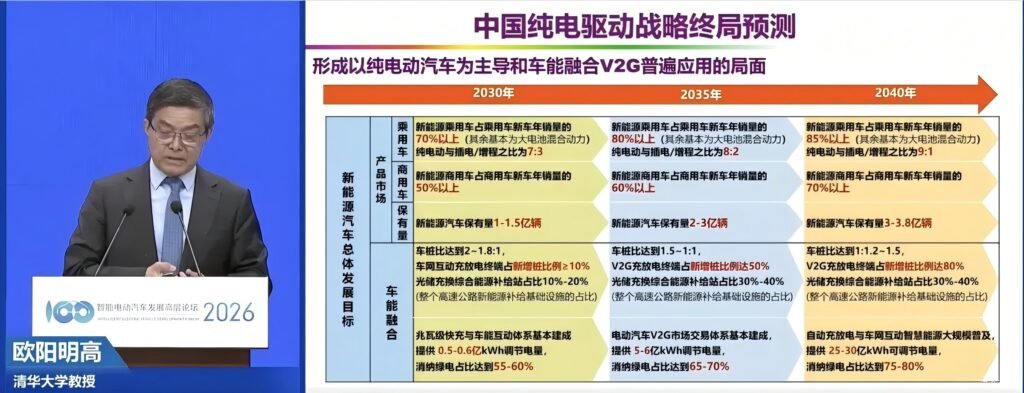
- The Ultimate Blueprint is Pure Electric: Academician Ouyang Minggao, a leading figure in China’s EV research, has painted a long-term vision. By 2040, he expects NEVs to hold over 80% of the Chinese passenger car market. Within that, the ratio of pure electric vehicles (BEVs) to plug-in hybrids (PHEVs) will evolve from 7:3 in 2030 to a dominant 9:1 by 2040.
The Bottom Line
The current wave of gasoline car price cuts is not a seasonal promotion. It is the sound of a century-old empire quietly retreating before our eyes. Strategies like “smart for oil” and “HEV push” might look like valiant efforts, but they appear more like the last rays of a setting sun.
The automotive industry’s century-defining transformation is accelerating faster than anyone predicted, heading towards a future defined entirely by electric power and intelligent code. One thing is certain: the road ahead will be a fascinating, and for some, a brutal, ride.